
You have decided to go after government construction work, you opened the first website someone pointed you to, and within ten minutes you hit a wall of acronyms — UEI, CAGE, NAICS, entity validation. This is where most contractors quit before they ever see a bid. Here is how to register on SAM.gov properly, in order, without paying anyone to do it for you.
How do you register on SAM.gov?
To register on SAM.gov you create a Login.gov account, request a Unique Entity ID (UEI) by entering your legal business name and physical address exactly as they appear on your official documents, pass entity validation, then complete the full entity registration — business details, NAICS codes, financial information for payment, and the representations and certifications. Registration is free, takes most contractors a few weeks end to end because of validation, and must be renewed every year.
Key Takeaways

- SAM.gov registration is free. Anyone charging you to register is selling you something you can do yourself.
- Your legal name and physical address must match your official records exactly — this is the single biggest cause of delays.
- The UEI replaced the old DUNS number in April 2022. If a guide mentions DUNS, it is out of date.
- You cannot be paid by the federal government without an active registration, so start it before you find a bid you want.
- Registration expires after one year. A lapsed registration makes you ineligible mid-pursuit.
Before you touch the website

Gather these first. Nearly every rejected registration fails on a mismatch, not on a hard question.
- Your legal business name exactly as it appears on your IRS documents or state formation paperwork — not your DBA, not the version on your truck.
- Your physical street address as it appears on those same documents. No PO boxes.
- Your Taxpayer Identification Number (TIN or EIN) and the name associated with it at the IRS.
- Your bank routing and account numbers for electronic payment.
- The NAICS codes that describe the construction work you actually perform.
If your state formation record says “Smith & Sons Construction LLC” and you type “Smith and Sons Construction,” validation can fail. That level of literal matters here.
The steps, in order
1. Create a Login.gov account. SAM.gov authenticates through Login.gov, so this comes first. Use an email you will still control in a year, when renewal comes around.
2. Request your Unique Entity ID. You enter your legal name and physical address, and the system attempts to validate your business against authoritative records.
3. Clear entity validation. If your details do not match, you submit documentation — your state formation paperwork or an IRS letter — to prove the business exists as described. This is the step that adds weeks, and it is the step worth being obsessive about.
4. Complete the entity registration. Choose registration for “All Awards” if you intend to bid on contracts, not just apply for grants. Add your NAICS codes, size information, points of contact, and banking details.
5. Work through the representations and certifications. A long series of yes/no questions about your business — size status, socioeconomic categories, legal standing. Answer honestly; these become part of your federal record.
6. Wait for activation, then verify. Once active, search your own entity on SAM.gov and confirm it appears publicly with the right NAICS codes.
Start at the official site: SAM.gov is the only place this is done, and it never charges a fee.
Free versus paid registration help
| Doing it yourself | Paying a registration service | |
|---|---|---|
| Cost of registration | $0 — always | $0 registration + their fee |
| Time it takes you | A few hours of your attention | Less of your time |
| Who fixes a validation rejection | You, using official documents | Them, but only with your documents anyway |
| Who understands your NAICS codes | You do | They guess from a short intake |
| Free official help available | Yes — the Federal Service Desk and APEX Accelerators | Not applicable |
There is nothing wrong with paying someone to save you time. There is something wrong with paying someone who implies the registration itself costs money, or who tells you a fee gets you approved faster. It does not.
If you want genuine free help, APEX Accelerators (formerly PTACs) are funded to advise small businesses on government contracting at no charge, and the U.S. Small Business Administration publishes plain-language guidance on federal contracting requirements.
Getting your NAICS codes right
This is the step contractors rush, and it quietly costs them work.
NAICS codes describe what your business does, and agencies use them to decide who a solicitation is even shown to. Pick codes that genuinely match the work you perform and can prove past performance in — commercial building construction, roofing contractors, electrical contractors, and so on. Listing thirty codes to widen your net does not help you; it puts you in front of buyers you cannot credibly serve and dilutes the picture of what you are actually good at.
Each NAICS code also carries a small business size standard. That standard determines whether you qualify for small business set-asides, which is where most contractors win their first federal work.
After you are registered
Registration makes you eligible. It does not make you competitive.
The next moves are the ones that separate contractors who register from contractors who win: setting up saved searches so relevant solicitations reach you, reading a few complete solicitation packages end to end before you ever bid, and going after set-aside opportunities rather than full-and-open competition where you are bidding against companies fifty times your size.
And renew on time. Your registration expires one year after activation. Contractors lose eligibility mid-pursuit every year because a renewal email went to an inbox nobody checks.
Get the process explained by someone who has done it
Federal Construction University teaches contractors the parts of government work that are gatekept — bidding, contract administration, project management, SAM.gov and certifications — from insider experience rather than theory. Students have gone on to $75M, $15M and $4.2M in nine months, and to first contracts in the $750K range.
If you want to talk through your specific situation, you can book a 30-minute complimentary consult with a business owner who has won millions in government contracts.
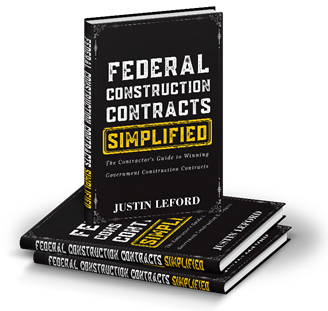
Prefer to start by reading? *Federal Construction Contracts Simplified* lays out the whole method — get it at federalconstructioncontractssimplified.com. It is not sold on Amazon.
Frequently Asked Questions
How much does it cost to register on SAM.gov?
Nothing. SAM.gov registration is free, and it always has been. Third-party services may charge a fee to handle the paperwork for you, but no fee is required to register and no fee makes approval faster.
How long does SAM.gov registration take?
The forms themselves take a few hours of focused attention. The overall timeline is usually a few weeks because entity validation has to confirm your business against authoritative records, and any mismatch in your name or address restarts that clock.
What is a UEI number and do I still need a DUNS number?
The Unique Entity ID (UEI) is the identifier the federal government assigns your business through SAM.gov. It replaced the DUNS number in April 2022. You no longer need a DUNS number, and any guide still telling you to get one is out of date.
Why did my SAM.gov entity validation fail?
Almost always a mismatch. Your legal business name and physical address must match your IRS or state formation records exactly — not your DBA, not an abbreviated version, and not a PO box. You resolve it by submitting your formation paperwork or IRS letter as documentation.
Do I have to renew my SAM.gov registration?
Yes, every year. Registration expires one year after activation, and an expired registration makes you ineligible for award — which contractors discover in the middle of a pursuit. Put the renewal date on a calendar you actually check.
Which NAICS codes should a construction contractor choose?
Choose the codes that genuinely describe work you perform and can show past performance in. Listing many unrelated codes does not widen your opportunities in a useful way; it puts you in front of buyers you cannot credibly serve. Each code also carries a size standard that determines your small business set-aside eligibility.